Q4 2026 Market Check-In
 By Matthew Finley•Uncategorized•READ TIME: 5 Min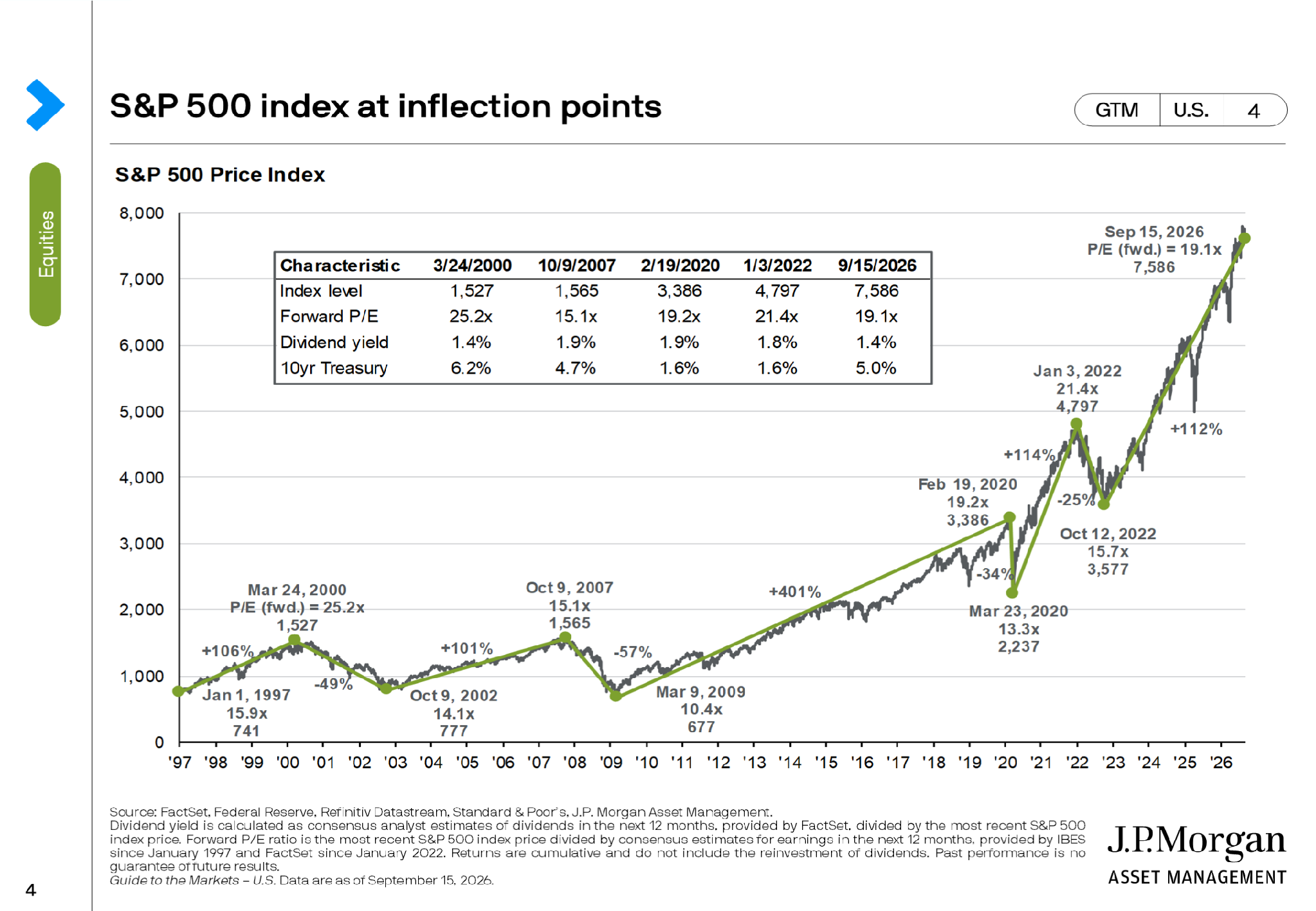
A quick recap on where we started 2026: our outlook called for 7–8% growth in the S&P 500, a modeled 6% return in the U.S. bond market, and a heads-up on a spring pullback in the 10% range — all wrapped in an overall view of a positive but unspectacular year. That thesis rested on four legs: an improving employment picture, a continued downtrend in inflation, healthy earnings growth, and forward progress on the AI and crypto buildout. With one quarter left in 2026, where do things stand? Let’s take a look.
Key Takeaways:
- Strong earnings continue to support the market. S&P 500 earnings growth remains robust, with Q3 2026 estimates pointing to another quarter of double-digit growth.
- The economic picture is mixed but improving. Employment appears to have stabilized and core inflation continues to move lower, although energy prices and geopolitical uncertainty remain risks.
- Portfolio positioning still requires flexibility. Strong earnings and a gradually improving economy provide support for markets, while valuations, Fed policy, geopolitical events, and the AI investment cycle remain important risks to monitor.
Where We Are So Far
As of this writing in mid-September, the market’s forward P/E sits at an average of 19.2x — a level that doesn’t look overextended and reflects expectations for double-digit earnings growth in 2027. Back in January, we were modeling S&P 500 earnings growth of 14% for both 2027 and 2028. Today those numbers stand a bit higher, at 15% and 17%, thanks to some of the strongest earnings we’ve seen in modern history.
We continue to believe that, over the long run, markets track company earnings growth. On that basis, we’re holding our year-end target in the 7,650–8,000 range for the S&P 500, with the index currently around 7,585. Looking further out, 2027 is shaping up to be another strong year — we’d put the range at 9–20% growth from now through the end of 2027. That’s a wide band, but earnings growth alone should be enough to keep markets moving higher for a number of months yet.
For context on just how strong that earnings backdrop is: FactSet’s latest Earnings Insight report puts the S&P 500’s estimated Q3 2026 year-over-year earnings growth at 28.7% — which would mark the third straight quarter above 25% and the eighth straight quarter of double-digit growth for the index. That report also puts the current forward 12-month P/E at 19.1, below the 5-year average but above the 10-year average (Source: FactSet Earnings Insight, John Butters, September 11, 2026).
S&P 500 index at inflection points, including current index level (7,586), forward P/E (19.1x), and dividend yield versus prior market peaks/troughs. Source: J.P. Morgan Asset Management, Guide to the Markets – U.S., data as of September 15, 2026.
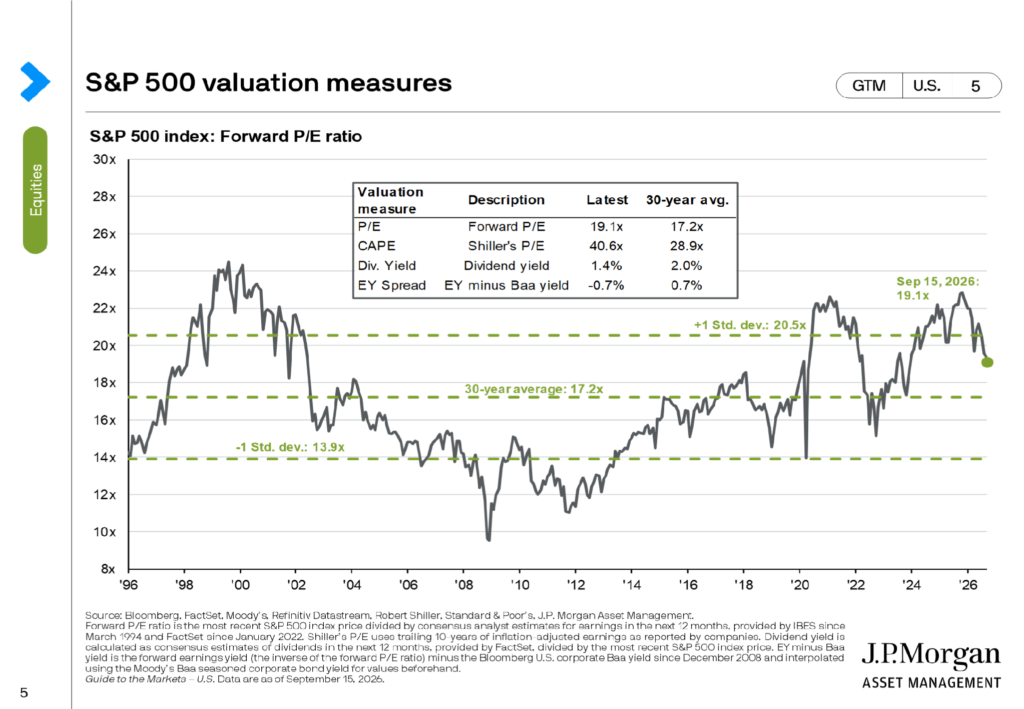
S&P 500 valuation measures, including forward P/E, CAPE, dividend yield, and earnings-yield spread versus 30-year averages. Source: J.P. Morgan Asset Management, Guide to the Markets – U.S., data as of September 15, 2026.
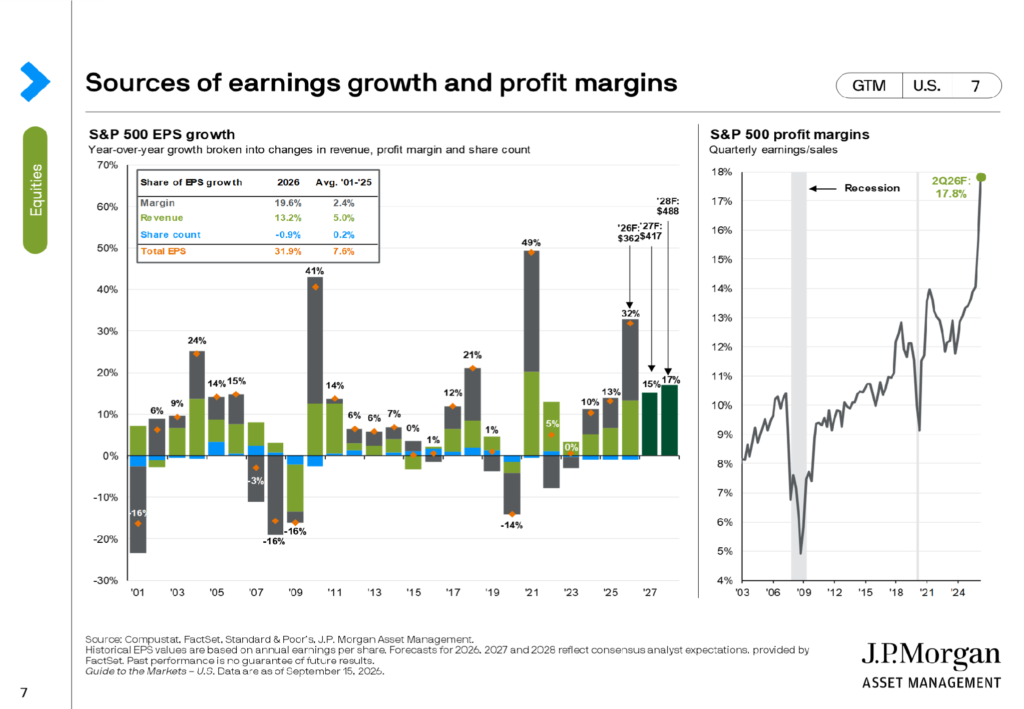
Sources of S&P 500 EPS growth (margin, revenue, share count) and quarterly profit margins, including 2026–2028 EPS estimates. Source: J.P. Morgan Asset Management, Guide to the Markets – U.S., data as of September 15, 2026.
Macro Check-In: Jobs, Inflation, and AI
Employment has been wobbly, to put it plainly, but it does appear we found a bottom earlier this year, as we’d hoped. The trend is pointing up, though we’d like to see it hold for a few more months before calling it confirmed. September’s payroll report put the 3-month average at 71,000 job gains — we typically want to see that number above 100,000 before feeling confident in the labor market.
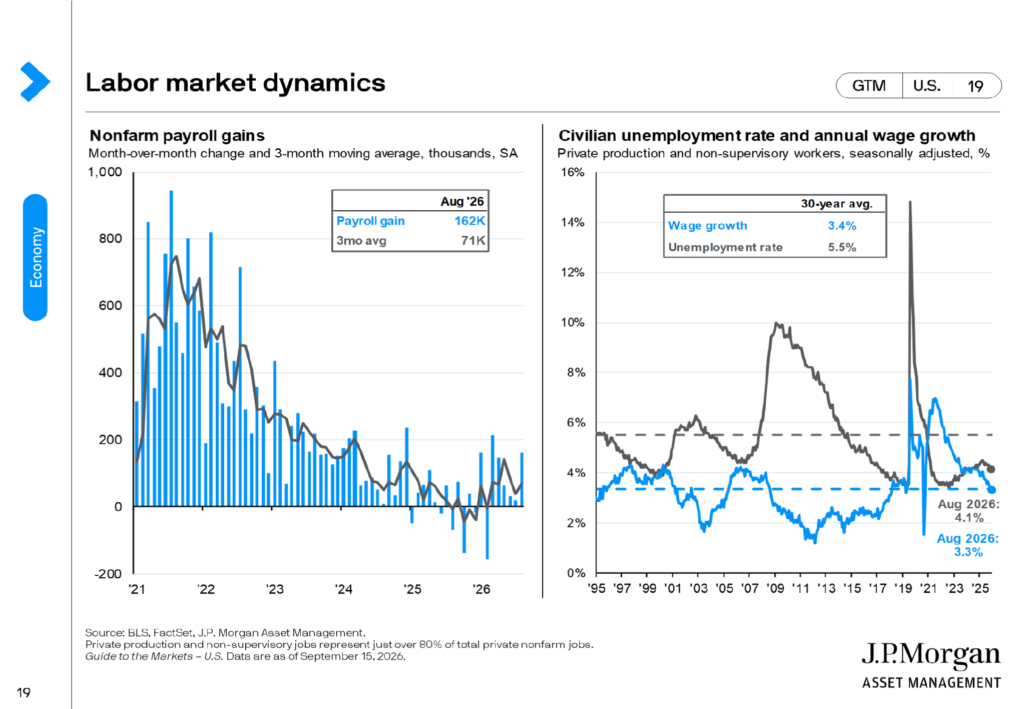
Nonfarm payroll gains (3-month moving average) and civilian unemployment rate/wage growth trends. Source: J.P. Morgan Asset Management, Guide to the Markets – U.S., data as of September 15, 2026.
Inflation has been the harder read, especially with the Iran conflict in the mix. Strip out energy and look at core components, and inflation continues to tick lower, moving toward the Fed’s target. Energy is the piece that’s pushed recent readings higher, driven by the escalation. Our view: inflation is in a good place overall, but the longer the conflict runs, the more it risks spreading into other categories. An oil deal with Venezuela and an eventual de-escalation in Iran would both work in inflation’s favor over the coming months and years. We’d prefer to see this resolved sooner rather than later, but even without that, inflation is still moving in the right direction over the longer term.
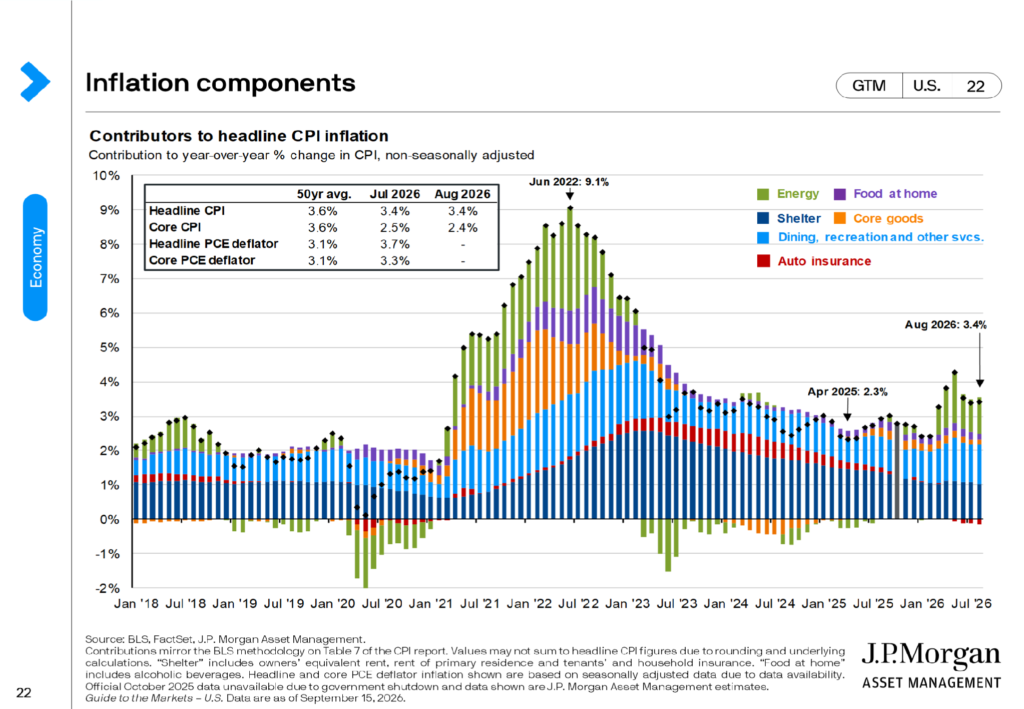
Contributors to headline CPI inflation, including the energy component driving recent readings higher. Source: J.P. Morgan Asset Management, Guide to the Markets – U.S., data as of September 15, 2026.
AI buildout and spending continue to accelerate. There’s no shortage of concern out there — negative returns on capital, broader worries about AI’s risks — but the numbers tell their own story. AI capital expenditures came in around $416 billion in 2025, are on pace to top $800 billion in 2026, and are projected to clear $1 trillion in 2027. That’s an extraordinary pace of spending, and at some point it needs to show up in earnings or the investment cycle will have to slow — a real risk worth watching. For now, though, AI is full speed ahead, with the next wave — self-driving and flying vehicles, robotics moving into industrial and everyday life — not far behind. Layer in the space economy tied to AI’s computational and server needs, and the picture ahead is both exciting and genuinely uncertain.
What This Means for Portfolios
So where does that leave us heading into the final quarter of 2026 and into 2027? Markets are in a relatively healthy place with room to grow. The S&P 500 has been roughly flat since June, when we last trimmed portfolio risk modestly while still leaning into stocks over bonds.
There’s a lot on the calendar: midterm elections just ahead, what appears to be a Fed rate hike incoming, and ongoing uncertainty around the Middle East and Ukraine. Under the surface, though, company earnings are strong, core inflation continues to trend lower, and a likely split Congress sets up a reasonably constructive backdrop for markets into 2027. Until we see a meaningful shift in the underlying data, we’ll maintain a slight lean toward pressing the accelerator a bit more in this longer-term expansion cycle.
The risks are real — a prolonged Iran conflict, election-related political risk, the chance of a policy misstep from the Fed or Treasury, among others. But a growing economy, improving employment, historically strong earnings, and a slow but steady decline in inflation should be enough to outweigh most of those risks for now.
Sources
J.P. Morgan Asset Management, Guide to the Markets – U.S., data as of September 15, 2026.
FactSet Earnings Insight, John Butters, VP Senior Earnings Analyst, September 11, 2026.
Related Posts
-
Q4 2026 Market Check-In
A quick recap on where we started 2026: our outlook called for 7–8% growth in the S&P 500, a modeled 6% return in the U.S. bond market, and a heads-up on a spring pullback in the…
5 Min ReadBy Matthew Finley
September 21, 2026 -

Q3 2026 Market Outlook
✅ Want a portfolio review that accounts for where markets are headed? Let’s connect → https://www.perspective6wealthadvisor… Markets are up over 8% on the year after a wild Q2, and most people didn’t see it coming. In…
2 Min Read
By Matthew Nelson
June 22, 2026 -

What Boston Scientific Employees Need to Know About Their Financial Benefits
Boston Scientific’s compensation package is one of the strongest in MedTech. Between the 401(k) match, the ESPP, the disability benefits, and the equity programs, there is a real opportunity to build wealth here. There is also…
8 Min ReadBy Matthew Nelson
June 12, 2026